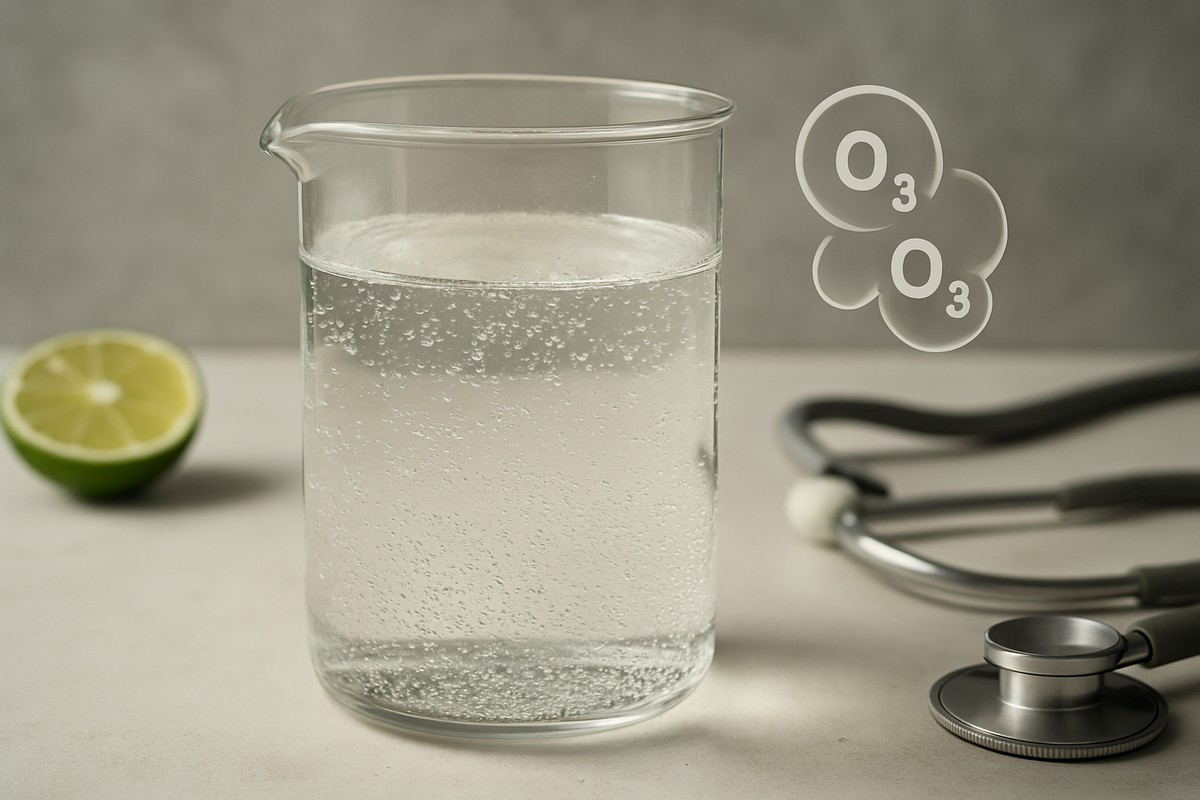
If you've ever taken a deeper breath after a storm and thought: "But fresh!", then... you have most likely smelt ozone. This inconspicuous gas, whose molecule resembles a triangle made of oxygen, has more talents than many a Marvel character. It can heal, disinfect, promote immunity. And on top of that, when it does its job - it disappears without leaving a mess - perfect, right?
Brew your coffee, because today I'm taking you on a journey through the world of ozone. And it won't be a dry chemistry lesson - rather, a story about a gas that should have its star on the pavement of natural medicine fame.
What are we dealing with?
Ozone, or O₃. It's not a secret formula or a new version of the iPhone. It's simply three oxygen atoms that have decided to join forces. The first two are the classic duo known as O₂ - the oxygen you just inhaled. But the third one? The third is a bit of a rebel. Unstable, hyperactive, looking for a partner to react with. And that's why ozone is so effective.
Interestingly, this chemical compound occurs naturally - especially after a storm, when lightning stirs the air like a giant blender. That's when you can smell that distinctive metallic odour. No, it's not ghosts - it's ozone!
And what's the story behind it? Well, in 1840, a clever guy called Schönbein (sounds like a character from 'Downton Abbey', but he was a chemist) discovered it and gave it a name. Since then, ozone has been doing well, although it is still somewhat in the shadow of more popular compounds.
Why does ozone deserve more of a fejm?
Firstly: is 120 times more effective than chlorine. Yes, you read that right. The same chlorine that you smell in the pool and that pinches your eyes, loses to ozone in a fight against bacteria and viruses like an amateur against a UFC champion.
Secondly: is eco. Ozone breaks down to pure oxygen. Zero plastic, zero toxins, zero 'sorry, but this substance can kill plankton'. Mother Nature gives it the green light.
Thirdly: is a ninja in the world of disinfection. Quiet, effective and leaves no residue. It is therefore used to clean instruments, operating theatres, water and... the body.
The entrance of the dragon, or ozone in medicine
OK, but how does it work on a person? After all, we don't inhale ozone through our noses like aromatherapy in a spa. Fortunately, medicine has found a way. Ozone therapy is a treatment that involves the controlled administration of ozone - sometimes intravenously, sometimes subcutaneously, sometimes in the form of an ozone bath. In short: we give the body a boost that stimulates the immune system, regenerates tissues and eliminates what is unnecessary.
Sound like magic? Rest assured, it's biochemistry. But one that works.
A list of uncool diseases, or what can be treated with ozone
Some diseases simply need a new approach - especially when antibiotics fail and standard treatment resembles a battle with windmills. And this is where ozone comes in. What can it help cure?
Skin problems
- acne (because pimples cannot tolerate pure oxygen),
- psoriasis, eczema, AD,
- hard-to-heal wounds, burns, impetigo.
Zoonoses
Because the dog not only barks, but sometimes brings Lyme disease as a free gift):
- Lyme disease, listeriosis, salmonellosis.
Respiratory system in trouble
- allergies, sinusitis, chronic rhinitis,
- drug-resistant pneumonia,
- Fungal lung infections (yes, they exist and are nasty).
Eyes can also be in trouble
- macular degeneration (dry form),
- retinal ischaemia.
Autoimmunity does not have to be a sentence
- Hashimoto's,
- Crohn,
- multiple sclerosis,
- lupus.
And when knees, back, joints hurt
- RA,
- degeneration,
- post-traumatic conditions,
- osteitis.
And something for the cardiac
- coronary heart disease,
- diabetic complications (e.g. diabetic foot),
- circulation problems, varicose veins, ulcers.
Ozone doesn't just cure - it also prevents!
Don't have any of the above diseases? Let's hope you stay that way! But even then ozone can help you:
- strengthens immunity - especially after illness or during the 'cold, cough, flu' season,
- improves efficiency - not only in professional athletes, but also in 'couch potatoes in transition',
- helps you recover from COVID,
- supports the body in chronic diseases.
Does ozone therapy have side effects?
Like everything - it depends on the dose. In low concentrations, it works like a Swiss watch. In too high concentrations, it is like an uncontrolled flamethrower. Therefore, ozone therapy should be carried out by a trained specialist, and not by Uncle Zbyszek with a garage full of equipment from Allegro.
This is not the end of his superpowers
What else ozone can do and how it works with the environment
- It supports antibiotics, even when bacteria have played the card: "I am resistant".
- Sometimes it allows you to replace them completely.
- It does not leave behind toxic waste.
- It does not accumulate in the tissues (unlike your collection of crisps in the body).
- It is gentle on the environment - planet Earth says "thank you!".
To conclude: is ozone a miracle?
No. But it very clever gaswhich, if used properly, can help your body to reach a higher level of health. It is not an elixir of immortality, but something much closer: a tool to support natural regeneration processes.
If you thought until now that ozone was just a layer in the atmosphere that protects us from UV - now you know that this hero has a few more aces up his sleeve. And you might want to take an interest in it before your body starts sending out an SOS of its own.
FAQ
Questions and answers
Yes - and quite sensibly too! Ozone therapy is often used for general support of the body - e.g. before cold season, during periods of increased stress, after intense physical exertion or when the immune system is weakened. It's a bit like a technical check-up for your body: seemingly everything works, but it's worth taking care before something breaks down.
With proper supervision - yes. In children, ozone therapy is used less frequently and only when there are specific indications, such as chronic infections or wounds that are difficult to heal. This must always be decided by a doctor with experience in ozone therapy. We are not playing with experiments here, but with well-documented clinical cases.
As much as possible - and this is one of its greatest strengths. Ozone therapy works well with antibiotics, physiotherapy, diet therapy or drug treatment. It does not compete with other methods, but supports them - like a well-chosen supplement that does not try to become the star, but complements the whole team.
It depends on the purpose of the therapy and the individual response of the body. For some patients, the improvement is already noticeable after the first treatment (e.g. in pain reduction or improvement in well-being), while others need a series of several sessions to notice a long-term effect. As a prophylactic measure, ozone therapy is sometimes applied periodically - e.g. once a month or every season.
Author of the article
